Soccer demands a rare combination of endurance, speed, coordination, and decision-making. Players cover long distances, accelerate suddenly, change direction constantly, and maintain control of the ball under pressure. Because of this, many athletes feel fit but still struggle with slowing down late in matches, losing balance during cuts, or lacking power in shots.
These problems usually don’t come from skill alone. They often stem from gaps in physical preparation. Proper soccer training, football (soccer) performance development, and soccer conditioning programs focus on preparing the body for the continuous, high-movement nature of the game.
Here’s how players can address common performance limitations.
Endurance That Matches the Game
Soccer is often seen as an endurance sport, but it’s not steady-paced jogging. Players move at varying speeds walking, jogging, sprinting, and cutting all within minutes.
Traditional long-distance running builds basic stamina, but it doesn’t fully prepare athletes for repeated bursts. Interval-based conditioning trains the body to handle constant pace changes. This improves a player’s ability to sprint late in matches and recover quickly after intense efforts.
When conditioning matches match-play demands, players maintain energy and focus throughout the game.
Acceleration and Change of Direction
Quick bursts often determine who reaches the ball first. Straight-line speed helps, but soccer relies heavily on sharp direction changes.
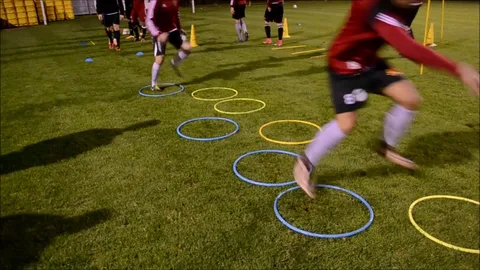
Agility and footwork training improve how efficiently players plant, cut, and re-accelerate. Strong hips and ankles allow smoother transitions, while coordination drills sharpen movement control at high speeds.
Better change-of-direction ability reduces slips and wasted steps, allowing players to react faster during both offense and defense.
Lower-Body Power for Kicking and Sprinting
Powerful shots and long passes come from more than leg swing strength. Force begins in the ground and travels through the hips and core.
Lower-body strength development improves how forcefully athletes push off during sprints and strikes. Strong glutes and hamstrings support explosive movements while reducing strain on the knees.
Rotational core strength also plays a role. A stable core allows better energy transfer when kicking or turning with the ball.
Balance and Body Control Under Pressure
Soccer players often control the ball while being challenged by opponents. Losing balance leads to turnovers and missed opportunities.
Training that focuses on single-leg stability and body awareness improves control during contact and quick movements. When athletes stay centered over their base of support, they maintain ball control more effectively.
Improved balance also lowers the risk of ankle and knee injuries.
Reducing Overuse Injuries
Soccer places repeated stress on the lower body, especially the hamstrings, hips, and calves. Without proper mobility, tight muscles restrict movement and increase injury risk.
A program that includes mobility training and recovery work helps maintain healthy range of motion. Dynamic preparation before activity and controlled stretching afterward keep muscles functioning properly.
When flexibility and strength develop together, athletes feel less stiffness and perform more comfortably.
Mental Sharpness and Physical Preparation
Fatigue affects decision-making. When players are physically prepared, they process plays faster and make better choices late in matches.
Physical readiness builds confidence. Athletes who trust their conditioning and movement ability focus more on tactics and teamwork rather than just trying to keep up.
Structured Development Matters
Improvement doesn’t come from random workouts. Effective athletic performance training builds strength first, then converts it into power and speed while maintaining endurance.
Tracking sprint times, jump ability, and recovery between efforts helps measure progress. Structured progression ensures steady improvement without burnout.
FAQs About Soccer Training
- How is soccer conditioning different from regular running?
Soccer conditioning involves changing speeds and directions, not just steady jogging. - Why is lower-body strength important for soccer?
Stronger legs improve sprinting, kicking power, and injury resistance. - How can players improve quick direction changes?
Agility drills and strength in the hips and ankles help athletes cut and accelerate efficiently. - Does balance training really help on the field?
Yes. Better balance improves ball control, stability in contact, and injury prevention. - How often should soccer players train outside practice?
Two to four focused sessions per week, depending on age and season, support performance without overtraining.
Final Thoughts
Soccer performance depends on endurance, quick acceleration, body control, and efficient movement. When training develops these areas together, athletes move more smoothly, maintain energy longer, and perform with greater confidence throughout the match. Smart preparation turns fitness into real game performance.